Reconnecting Communities: 9W Reconfiguration Study

Share Reconnecting Communities: 9W Reconfiguration Study on Facebook Share Reconnecting Communities: 9W Reconfiguration Study on Twitter Share Reconnecting Communities: 9W Reconfiguration Study on Linkedin Email Reconnecting Communities: 9W Reconfiguration Study link
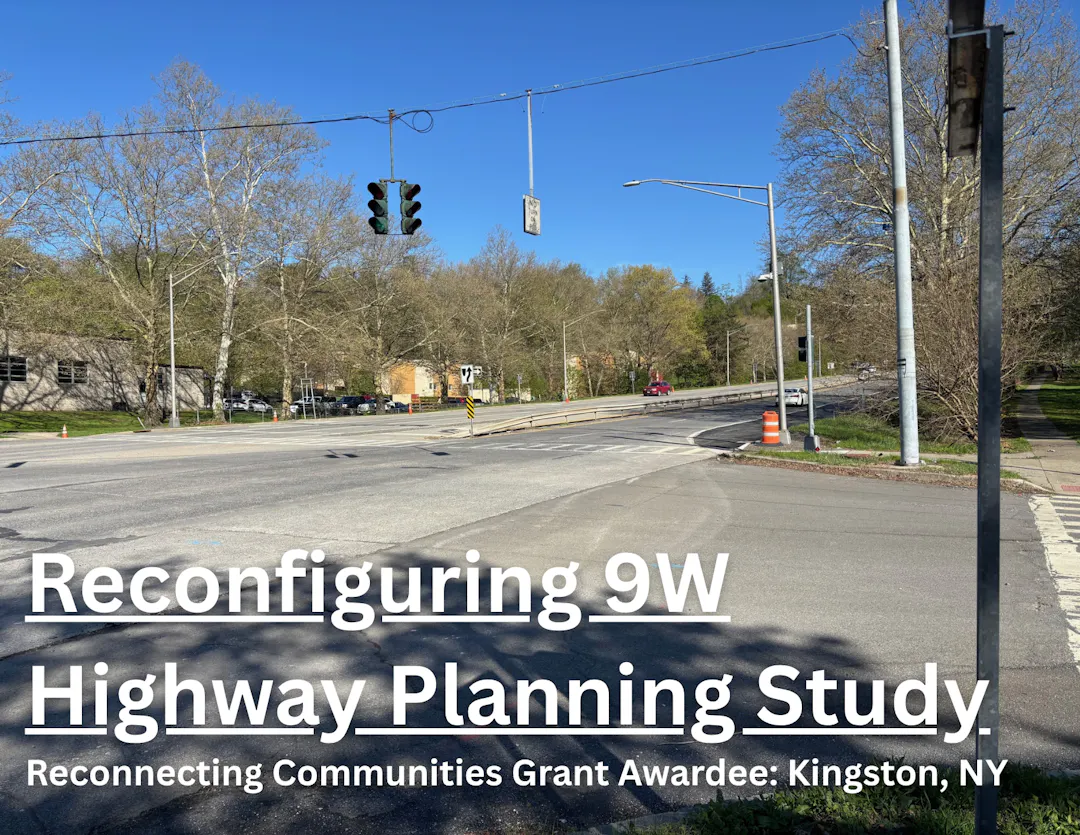
In late 2024, the City of Kingston applied for a $240,000 Reconnecting Communities planning grant from the US Department of Transportation, and was awarded in Jan. 2025.

Through a comprehensive design and community engagement process, the City will explore ways to reconnect neighborhoods separated by Route 9W while ensuring the highway maintains its overall level of service for current and projected traffic counts.

Community Engagement

The project and its work will be guided by a strong focus on community engagement. Public engagement activities will include meetings with people who live in and near the project area, surveys, and other ways of making sure folks can learn about and contribute to project plans.

As of April 2026, community engagement for this project has not yet begun. To stay updated on opportunities to get involved, subscribe to this project.

Project Specifics

The planning efforts of this project fall into three categories: Concept Development (creating corridor scenarios that include redesigns such as reduction of lanes), Land Use & Placemaking (evaluating opportunities to use reclaimed land for housing and other uses), and Ownership (evaluating legal, operational, and financial consequences for transferring roadway jurisdiction).

Priorities of the project include safety for all users, mobility and accessibility across modes, economic development and housing potential, environmental impacts, cost and constructability.

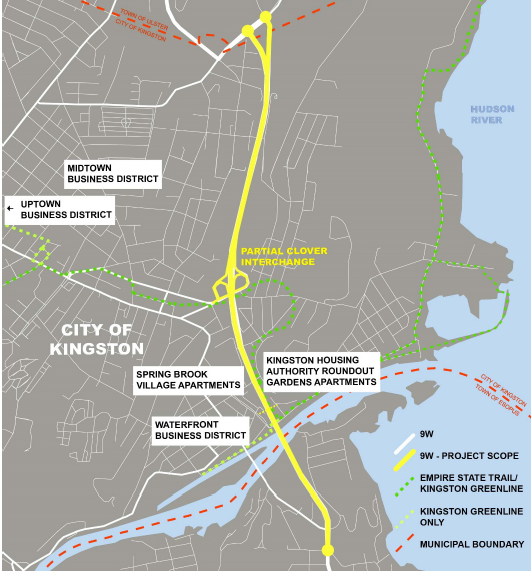
The study area includes the 1.9 miles of Route 9W traversing the City of Kingston along with a 0.4-mile segment in the Town of Esopus and a 0.1-mile segment in the adjacent Town of Ulster. At times, the right of way for Route 9W is over 200 feet.

History

During the 1950s and 1960s, interstate highways were being built across the United States, demolishing and separating neighborhoods in the process. Kingston was no exception. 9W was built through the city after hundreds of buildings were demolished and thousands of people were forced to relocate during urban renewal efforts in the 1960s. For more information on the history of urban renewal in Kingston, see here.

Thank you to the researchers David Hochfelder (University of Albany) and Ann Pfau (independent scholar) for their insights on the history of 9W.

In late 2024, the City of Kingston applied for a $240,000 Reconnecting Communities planning grant from the US Department of Transportation, and was awarded in Jan. 2025.

Through a comprehensive design and community engagement process, the City will explore ways to reconnect neighborhoods separated by Route 9W while ensuring the highway maintains its overall level of service for current and projected traffic counts.

Community Engagement

The project and its work will be guided by a strong focus on community engagement. Public engagement activities will include meetings with people who live in and near the project area, surveys, and other ways of making sure folks can learn about and contribute to project plans.

As of April 2026, community engagement for this project has not yet begun. To stay updated on opportunities to get involved, subscribe to this project.

Project Specifics

The planning efforts of this project fall into three categories: Concept Development (creating corridor scenarios that include redesigns such as reduction of lanes), Land Use & Placemaking (evaluating opportunities to use reclaimed land for housing and other uses), and Ownership (evaluating legal, operational, and financial consequences for transferring roadway jurisdiction).

Priorities of the project include safety for all users, mobility and accessibility across modes, economic development and housing potential, environmental impacts, cost and constructability.

The study area includes the 1.9 miles of Route 9W traversing the City of Kingston along with a 0.4-mile segment in the Town of Esopus and a 0.1-mile segment in the adjacent Town of Ulster. At times, the right of way for Route 9W is over 200 feet.


History

During the 1950s and 1960s, interstate highways were being built across the United States, demolishing and separating neighborhoods in the process. Kingston was no exception. 9W was built through the city after hundreds of buildings were demolished and thousands of people were forced to relocate during urban renewal efforts in the 1960s. For more information on the history of urban renewal in Kingston, see here.

Thank you to the researchers David Hochfelder (University of Albany) and Ann Pfau (independent scholar) for their insights on the history of 9W.

Do you have a question about this Reconnecting Communities planning grant? Ask it here.

Email
loader image
Didn't receive confirmation?
Seems like you are already registered, please provide the password. Forgot your password? Create a new one now.
  • Share How are Kingston and Esopus working together on this project? And how is the current traffic problem in Port Ewen (and increased housing & visitor traffic) being factored in? Thanks! on Facebook Share How are Kingston and Esopus working together on this project? And how is the current traffic problem in Port Ewen (and increased housing & visitor traffic) being factored in? Thanks! on Twitter Share How are Kingston and Esopus working together on this project? And how is the current traffic problem in Port Ewen (and increased housing & visitor traffic) being factored in? Thanks! on Linkedin Email How are Kingston and Esopus working together on this project? And how is the current traffic problem in Port Ewen (and increased housing & visitor traffic) being factored in? Thanks! link

    How are Kingston and Esopus working together on this project? And how is the current traffic problem in Port Ewen (and increased housing & visitor traffic) being factored in? Thanks!

    SharonB asked 4 days ago

    While most of the study area is in Kingston, there is a length of 9W in Esopus that is also part of the proposed study area. If this part of the corridor is part of the study that happens, the intention would be to solicit feedback from Esopus businesses, leaders and residents on any potential changes. 

    As part of the study, we will ask the consultants to factor in historical, current, and projected traffic counts. 

    Thanks,

    Bartek

Page last updated: 01 May 2026, 11:14 AM